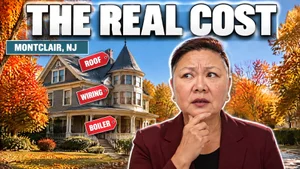
Buyers ask this one more than almost anything else about Montclair. The houses are turn of the century. They are beautiful. Are they going to cost a fortune to keep?
Here is the short answer. On a Montclair house around a century old, a full electrical rewire runs $8,000 to $15,000, and $20,000 to $25,000 on a large house. Adding central air starts around $20,000. Replumbing out of galvanized steel runs $10,000 to $20,000. A roof can reach $30,000 on a wide single-story footprint. Windows run $10,000 to $30,000 for a whole house. Significant foundation work, which is uncommon, can reach $50,000. Most houses need some of this, not all of it, and almost none of it is a surprise if you inspect properly and get quotes.
Why Montclair houses are old
Montclair is historic, and that is the whole appeal. The bones are remarkable and the character is something new construction does not approach. It also means a house built in the early 1900s may have outdated electrical or plumbing, may never have had central air installed at all, and is sitting on a foundation that was poured more than a hundred years ago.
None of that is a reason to walk away. It is a reason to look honestly at what a given house needs and what that costs.
What each system costs
| System | Typical Montclair cost | What to know |
|---|---|---|
| Electrical, full rewire | $8,000 to $15,000, or $20,000 to $25,000 on a large house | Knob and tube cannot be brought up to code and should come out. Budget wall repair on top, since updating wiring often means opening walls. |
| Central air added | From $20,000 | Roughly a third of Montclair's century homes already have it. You can add central air and keep the original boiler or steam system running alongside it. |
| Ductless split system | $15,000 to $30,000 | Priced like central air and depends on how many units you need. Lets you condition one part of the house and shut the rest off. |
| Replumbing | $10,000 to $20,000 | Copper is usually fine. Galvanized steel at this age is corroding and should be replaced. Cost varies with the material you run, PEX included. |
| Roof | About $30,000 on 4,500 square feet of roof | That is the outside number on a wide single-story footprint. A colonial, Tudor or Victorian stacks its floors, has far less roof surface, and costs less. A good architectural asphalt roof gives you 30 plus years. |
| Foundation | A small patch, up to about $50,000 for significant work | Cracks in a hundred-year-old foundation are normal and the vast majority are cosmetic. The $50,000 cases exist but they are rare, and an inspection catches them. |
| Windows, whole house | $10,000 to $30,000 | Mid-range double pane performs close to premium brands on efficiency. Original leaded glass with working storm windows behaves like double pane and can be kept. |
| Asbestos pipe wrap | Remediate when there is more than three feet of it | It was used because it insulated well. It gets wetted down during removal so it does not become airborne. |
| Asbestos 9x9 floor tile | Encapsulate rather than remove | A nine by nine inch tile in a basement is almost certainly asbestos. Removal means scraping and breaking it, which releases fibers. Covering it over is usually the better answer. |
Ranges reflect the Montclair market as of October 2026 and are not quotes. Get your own estimates on your own house.
Electrical
If the house has knob and tube, it needs to come out. At this point it is not something that can be brought up to code. Expect $8,000 to $15,000 depending on size, and $20,000 to $25,000 if the house is especially large.
One cost people forget: electricians sometimes have to open walls to pull new wire. Budget for patching and repainting those surfaces.
Heating and cooling
A century house in Montclair may well have no central air. Around a third of them do. The rest have been running window units.
You do not have to choose between old and new. You can put central air in and keep the original boiler, whether that is a hot water or a steam system. A lot of buyers specifically want that, because forced hot air dries the house out over a North Jersey winter in a way steam does not.
A full replacement, pulling the original system and putting in forced air, runs north of $20,000. Ductless splits land in the same range, $15,000 to $30,000 depending on how many heads you need, and they are getting more popular because you can run one zone and leave the rest of the house alone.
Plumbing
Copper is usually fine. Galvanized steel is the problem, and at this age it is corroding. A replumb runs $10,000 to $20,000 depending on what you run in its place.
Roof
Roofs are expensive right now. A lot of Montclair houses have architectural asphalt that has been up 15 or 20 years, and with some repair along the way you can get 30 plus years out of that roof.
For scale: 4,500 square feet of roof surface on a single-story footprint runs about $30,000 to replace in like kind in New Jersey today. If your house is a colonial, a Tudor or a Victorian, the floors are stacked, there is much less roof up there, and the number drops accordingly.
Foundation
Cracks in a hundred-plus-year-old foundation are normal, and the vast majority are cosmetic. Occasionally one is structural.
On assessment, the practical move is to talk to an architect or a structural contractor rather than going straight to a structural engineer. An engineer is not the person doing the work, and a contractor who looks at the crack can usually tell you what kind it is, whether it needs attention now, and what it costs, in one visit.
Range is wide. Patching a small crack is minor. Significant work, a front foundation moving left or right, can reach $50,000. That is the rare case, and it shows up at inspection. When it does, that is a price conversation.
Windows
Whole-house window replacement runs anywhere from $10,000 to $30,000, and most of the spread is the product you choose rather than the house.
Worth knowing before you spend up: premium brands and sensible mid-range brands perform closer together on energy efficiency than the price gap suggests. Nobody walks into a house and offers more money because the windows are a particular brand. They look for new windows with a decent efficiency rating.
Double pane over single pane, every time. Single pane does not insulate well enough.
And if the house has original leaded glass, that is not a problem to solve. With the storm windows on, that assembly works like double pane and can be genuinely efficient. If the character of the house is what you came for, keep the windows.
Asbestos
Two places to look.
Pipe wrap, along the heating pipes. More than three feet of it gets remediated, and on a purchase that is something to push for the seller to handle. Removal involves wetting it down so nothing goes airborne.
Nine by nine inch floor tiles, usually in a basement. If the tile measures nine by nine, assume asbestos. The concern here is less removal than what removal does, because tile cannot be wetted down. Scraping and breaking it releases fibers. Encapsulating it, which means covering it with new flooring, is usually the better outcome.
How to evaluate a specific house
Get the inspection. Even if you are waiving inspection remediation and accepting that you will absorb repairs, do the inspection. Then ask the inspector three questions: what here is cosmetic, what is urgent, and what is coming in the next five years.
Get quotes, do not guess. If a system needs work, get a real cost estimate on it before you are committed. If your agent is not asking for quotes, ask them to.
Match it to how long you are staying. Work that has to happen now needs money set aside now. Work that is three or five years out is a savings plan. Both are manageable. Neither should be a surprise.
If you are selling an older Montclair home
The water heater that has been there since you bought the house 25 years ago is going to come up at inspection. So is everything else at the end of its life.
If every major system is on its last legs, that shows up in the report and it shows up in what a buyer is willing to pay at closing. Doing some of that work ahead of listing, or at minimum having a plan and quotes ready for the inspection period, protects your number. No buyer pays top dollar for a house they think is about to go kaput.
Is a century home right for you?
Honest answer: not for everyone, and that is fine.
If you are not interested in being the steward of a turn of the century house, a historic colonial is not the right target, and we should not be looking at them. Montclair also has 1940s and 50s colonials, mid-century houses, and newer construction, all of which give you more runway on the major systems.
The point is to make that decision deliberately, with real numbers, while you are still looking. Your agent should be doing that with you.
Frequently asked questions
Does buying an old house in Montclair mean higher property taxes?
No. A sale does not trigger a reassessment in New Jersey. Assessments move when the town does a revaluation, or when permits are pulled and an added assessment follows.
Is knob and tube wiring safe to leave in place?
It should come out. At this point it is not something that can be brought up to code.
Can I add central air without losing the original radiators?
Yes. You can run central air and keep the original boiler, hot water or steam, at the same time. Many buyers prefer that combination.
How do I know if a basement floor tile is asbestos?
Measure it. A nine by nine inch tile is almost certainly asbestos. Covering it is generally better than removing it.
Are premium windows worth the money in an old house?
Usually not on efficiency alone. Mid-range double pane performs close to premium. And original leaded glass with storm windows can outperform expectations.
Talk it through
If you are buying in Montclair and you want to walk through what a real inspection looks like on a house like this, Nancy will go through it with you. If you own an older Montclair home and you are trying to work out what to do before you list it, same.
Nancy Chu · 917.992.3098 Free guide: Moving to Montclair → montclair.nancychuhomes.com
Nancy Chu, Sales Associate NJ Real Estate License #0568990 KELLER WILLIAMS NJ Metro Group · License #1008274 Office: 973-783-7400 Each office is independently owned and operated.